Guides
R-134a or R-1234yf? How to Tell Which Refrigerant Your Car Uses
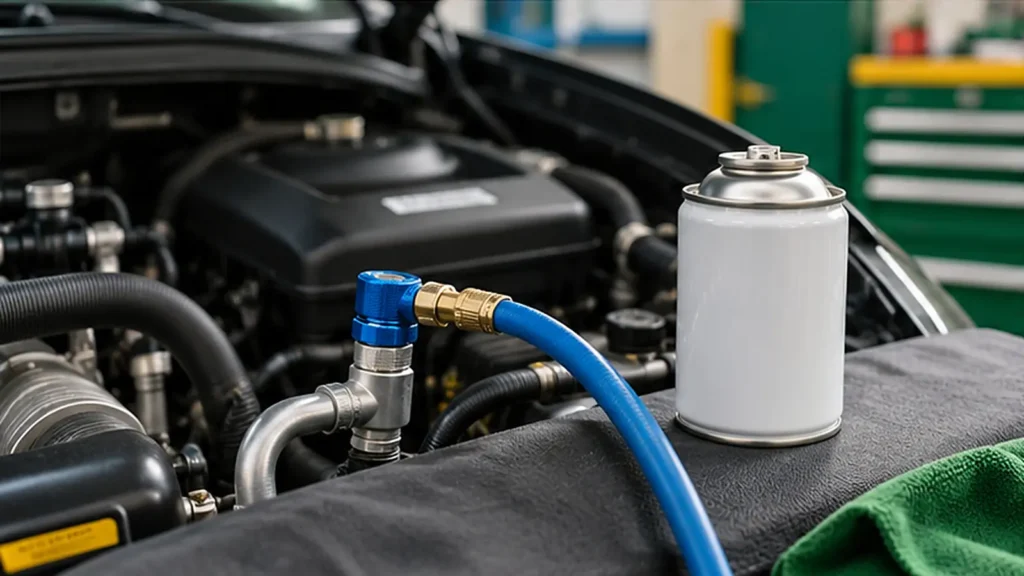
If your car’s air conditioning is blowing warm, the first question is which refrigerant the system uses. For most vehicles on U.S. roads the answer is one of two: R-134a or R-1234yf. They are not interchangeable, so it pays to check before you buy anything.
Quick answer: look for the A/C label under the hood. It names the refrigerant and the charge amount. As a rule of thumb, older vehicles use R-134a and most newer vehicles use R-1234yf, but the label on your car is what counts.
R-134a and R-1234yf in a nutshell
- R-134a became the standard car A/C refrigerant in the 1990s, replacing R-12. It has a GWP (global warming potential) of about 1,430.
- R-1234yf was introduced to cut climate impact. Its GWP is below 1, and carmakers switched to it over the 2010s. Most new cars and light trucks sold in the U.S. today use it.
R-1234yf is classified as A2L, meaning lower flammability. Vehicle systems designed for it include safety features for that, which is one reason the two refrigerants must never be swapped or mixed.
How to check which refrigerant your car uses
- Find the under-hood A/C label. It is usually on the underside of the hood, the radiator support or near the front of the engine bay. It states the refrigerant type (for example “HFC-134a” or “HFO-1234yf”) and the charge amount.
- Check the owner’s manual. The specifications section lists the refrigerant and the A/C compressor oil.
- Look at the service ports. R-1234yf systems use different service port fittings from R-134a systems, so the equipment for one does not connect to the other. This is a deliberate design to prevent mix-ups.
- Still not sure? Ask a dealer or an MVAC technician with your vehicle identification number (VIN).
Why you should never mix them
- Performance and damage: the two refrigerants have different pressures and use different oils. Mixing can reduce cooling and damage the compressor.
- Safety: a system designed for R-134a was not engineered for a lower-flammability refrigerant, and the reverse is also true.
- Contamination: a mixed charge cannot simply be topped up later. Shops identify and recover contaminated refrigerant with special equipment, which adds cost.
- Rules: using a refrigerant other than the one the system was designed for, without following EPA’s requirements for substitutes, is not allowed.
Doing it yourself vs. a certified technician
Do-it-yourself: car owners without certification may buy small cans of 2 pounds or less with a self-sealing valve to service their own vehicle. Use the correct refrigerant for your car, follow the instructions on the can, and do not overfill. Too much refrigerant cools worse, not better.
Certified technicians: larger containers of MVAC refrigerant may only be sold to technicians certified under EPA Section 609, or to businesses that employ them. Under Section 609, anyone repairing or servicing vehicle A/C for payment must be certified and must use approved recovery or recycling equipment. Venting refrigerant into the air is prohibited.
Not sure whether you need certification for what you are ordering? Our guide Who Can Buy Refrigerant? explains the rules.
Signs your A/C may be low on refrigerant
- air from the vents is cool but not cold, or gets warmer while driving;
- the A/C compressor clutch cycles on and off frequently;
- visible oily residue around A/C lines or fittings, which can point to a leak.
Refrigerant does not get used up. If the system is low, there is a leak somewhere. Recharging without fixing the leak is a short-term fix at best.
Frequently asked questions
Can I convert my R-134a car to R-1234yf, or the other way round?
Converting is not a simple refill and is not recommended. Always use the refrigerant shown on your vehicle’s label.
Why is R-1234yf more expensive?
It is a newer, more complex chemical with fewer producers than R-134a. Prices can change over time.
Is R-1234yf dangerous?
It is low-toxicity and lower-flammability. Vehicle systems are designed for it, and it is safe when handled according to the instructions and safety data sheet.
Official sources
This article is general information, not legal or mechanical advice. Always follow your vehicle manufacturer’s instructions. Questions? Contact our team or browse our refrigerants.